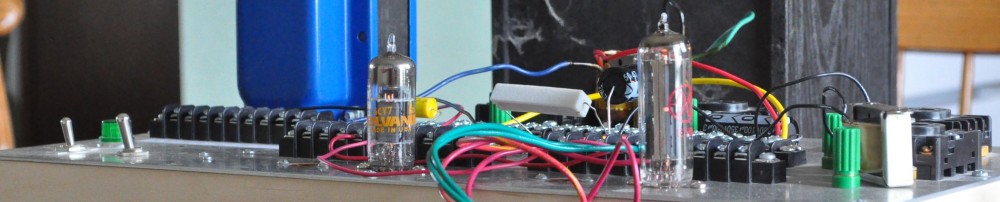
I haven’t gotten the time to complete the testing on the Curly Maple yet, but I did receive a couple of tubes for which I’ve been waiting so I can try them in the new amp.
The bias point for the Curly Maple, while chosen specifically for the 6V6, supports operation of the entire 6V6 and 6L6 families of tubes as well as the 6F6. The 6W6 also worked out well in the Marblewood, but my fear is that the Curly Maple may be a little to hot for the 6W6 tubes.
However, it was suggested to me that I try out some 6K6 power tubes. The ones I ordered finally arrived.
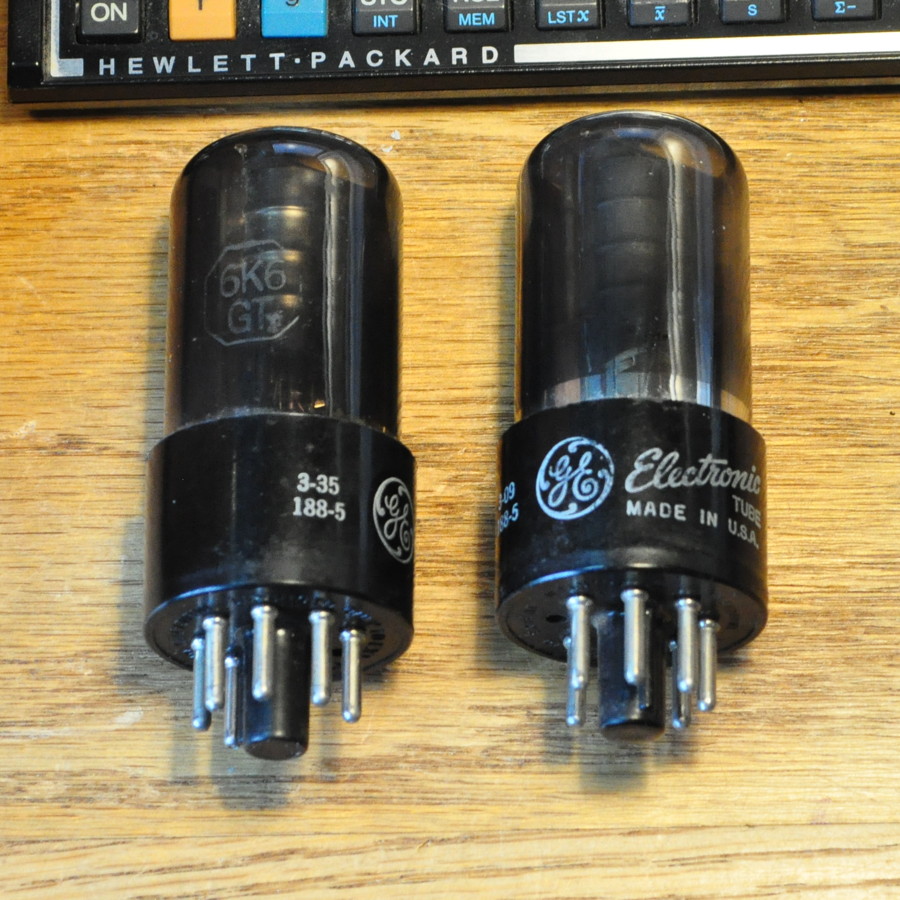
The 6K6 is, like the 6F6, not a beam power tube but a true pentode. Now pentodes behave a little differently than beam power tubes in UL typologies. But, after looking at the data sheets, I decided I would give them a try in the curly maple. My only real concern is that the maximum plate dissipation for the 6K6 is only 8 watts. However, if the power dissipations are within specification, I’ll take a few measurements and see how they sound. I may also give them a try in the Marblewood as well.
As always, questions and comments are welcome.
Matt,
I’ve been kicking around an idea in my head for a few days. Let’s say you have two amps with equally flat frequency response curves. One amp is SET (e.g. 300B) and the other is SE-UL (e.g. 6L6). Both are tested with the same source and speakers, however, one has a pronounced mid-scoop sound. Is this more likely a property of the specific tubes (something tube rolling could address), or is it a more complex or nuanced issue such as an inherit trait of the topology, internal components, or the amp’s interaction with the impedance of the speaker?
Would appreciate your thoughts on the matter. Thanks.
A difficult question. But I’m a little confused by your description. You start by stating that the amps have an equally flat frequency response curves but then follow up with one having a “mid scoop” (i.e. suppressed mid frequency response) sound. So which is it? Equally flat responses or one with suppressed mid-range frequencies? And how were the frequency responses measured? I’m not sure the typologies would make any difference except perhaps in damping factor, which typically manifests in uncontrolled bass response not mid range scoop.
If the amps are married with appropriate speakers, such a difference should not occur. Many modern speakers are ill suited to use with vacuum tube amplifiers specifically due to tube amplifiers higher output impedance. But a mid-scoop (if not induced with equalization) is most likely an issue with speaker response and not tube amplifier topology.
Not that I’m a believer in the appropriateness of the “flat response” speaker. I typically look for speaker response I like (with the intended amplifier and music genre) rather than some arbitrarily flat response curve. Can you provide a little more insight on your question?
Let me try to expand a bit.
Frequency Response Procedure:
Each amplifier channel is connected to an 8 ohm dummy load resistor and a spectrum analyzer tool records the frequency response sweep of each amp. In the case of both amps, the frequency response is more or less perfectly flat from 100 Hz to 10,000 Hz at the same power level (let’s say 0.1 Watts).
Listening Procedure:
Now, each amp is listened to individually using the same source and speakers. One of the amps is perceived to have a very noticeable mid-scoop in sound.
For reference, the speakers are vintage Wharfedale Denton 6-ohm speakers. I have also tested the amps with modern 8-ohm speakers and results are more or less the same. Both amplifiers utilizes 8-ohm output transformers.
This, to me, sounds like a speaker/amp mismatch. I’m guessing that it’s the SET that sounds low on the mids. Probably because of poor woofer control in the low frequencies and a shouty tweeter. I’m guessing that the mids are fine and both ends are sub-par. SETs (in particular those with zero feedback) need a very tight speaker to really shine. This is why the mid-szie full range drivers are such favorites for SETs. And if the speaker is a three way, forget a SET ever sounding really good. My favorite speaker configuration for SETs is a tight small-ish woofer (≈6″) and a single tweeter with a simple single pole crossover.
Now you can tell me if I called it all wrong.😮 I could probably answer your question a lot better with some more information about the specific topology of each amplifier and the speaker configurations used. Send me a direct email and we can discuss further if you like.
Thanks Matt, I’ll send an email.
After looking at a few data sheets:
As you said plate dissipation of a tad over 8 watts (8.8) – kind of “light duty”
Has pretty high THD – up to 15% in SEP operation, don’t know what that means for SEUL operation.
And, most of the sheets seem to steer you to 250V plate voltage.
As for the 6V6 – there is a lot more tube in there than the data sheets suggest. Some guitar amps run 6V6’s under conditions that should cause the tube to explode, but they don’t – they keep booking right along.
After working with the characteristics curves, my concern is that the 6K6 is going to bias around 45mA to 48mA with about 280V on the plate. This corresponds to about 13W of plate dissipation. This is way too hot for the 6K6. I might even do a little prototype characterization before I plug it into the amp. My current feeling is that the cathode bias resistor may be too low for the 6K6 at this voltage level. We’ll have to see once I get the Curly Maple 6V6 characterization complete.
Interested to hear how it goes! I’ve used 6K6’s in place of 6V6’s in a Bottlehead Moreplay – they sounded quite good. I’ve since found some JAN Sylvania 6V6’s that sound even better in it. I just recently finished an amp based on your spalted alder design – it sounds great! Will be doing some testing soon.
Looking forward to hearing your thoughts. I see these tubes in old radios that people no longer want, and wonder if they could get a new purpose. Your pair looks great!