In my last post I discussed what it means to make an amplifier go to 11. But in spite of the issues involved, many amp builders simply can’t help themselves. Even before the first connection is made they start craving more power. However, the truth of the mater is that increasing amplifier power is almost always a fool’s errand. And even the rated power outputs of most commercial amplifiers have nothing to do with listening, and everything to do with marketing.
So now that we’ve discussed what it means to “go to 11” let’s discuss why the quest for more power is almost always the wrong decision.
Power, Sound Pressure Levels, and What’s “Loud”
This discussion begins with that same plot of SPL verses amplifier power from my last post.
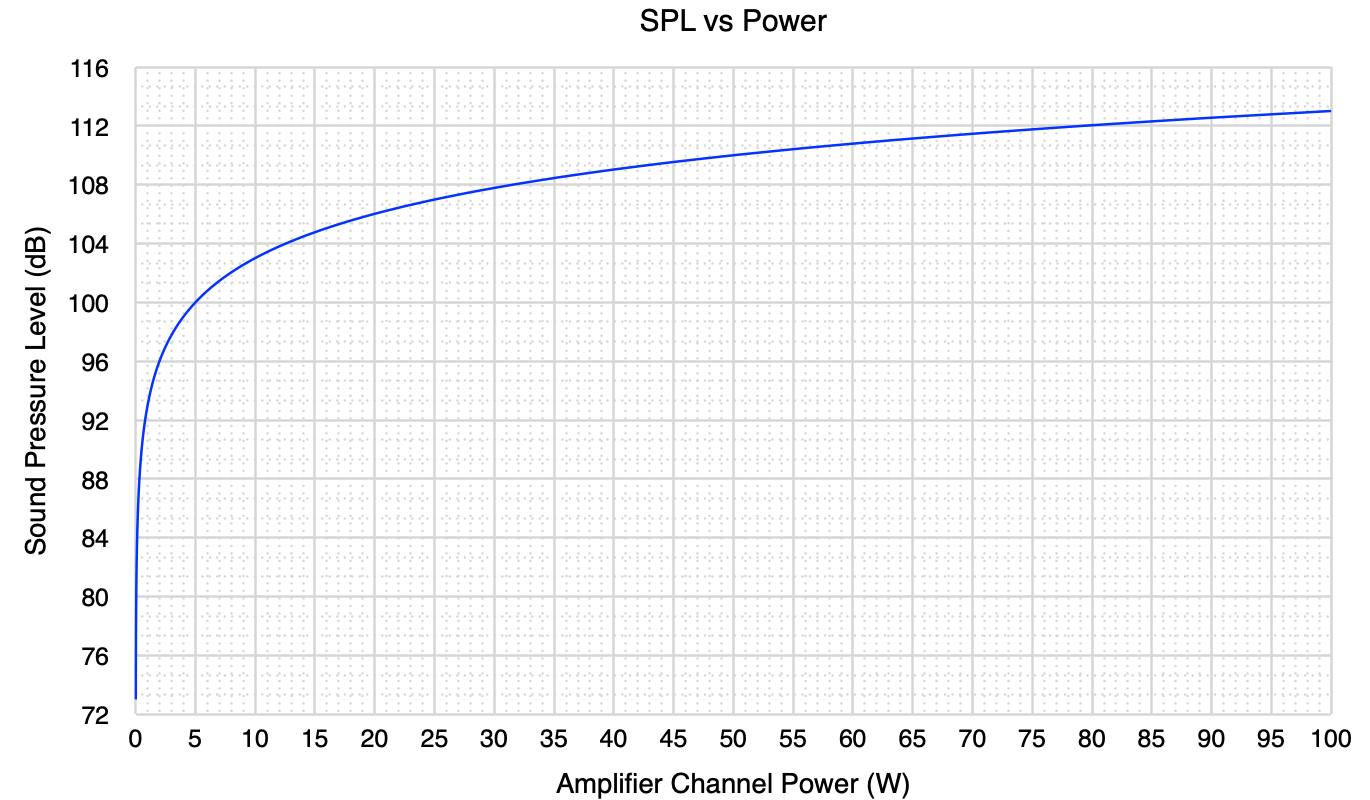
The primary problem with this graph is that it lacks context. It’s easy to say you want some particular dB SPL, then look at the graph and pick a power level for your amp. But what do the SPL levels really mean?
First, I want to put some context to the graph above. Here is the same graphic but with some limits for unprotected exposure to prevent hearing damage from the US National Institute for Occupational Safety and Health (NIOSH). I am going to propose (at least as a working argument) that one of the goals for music listening is that it shouldn’t damage our hearing.
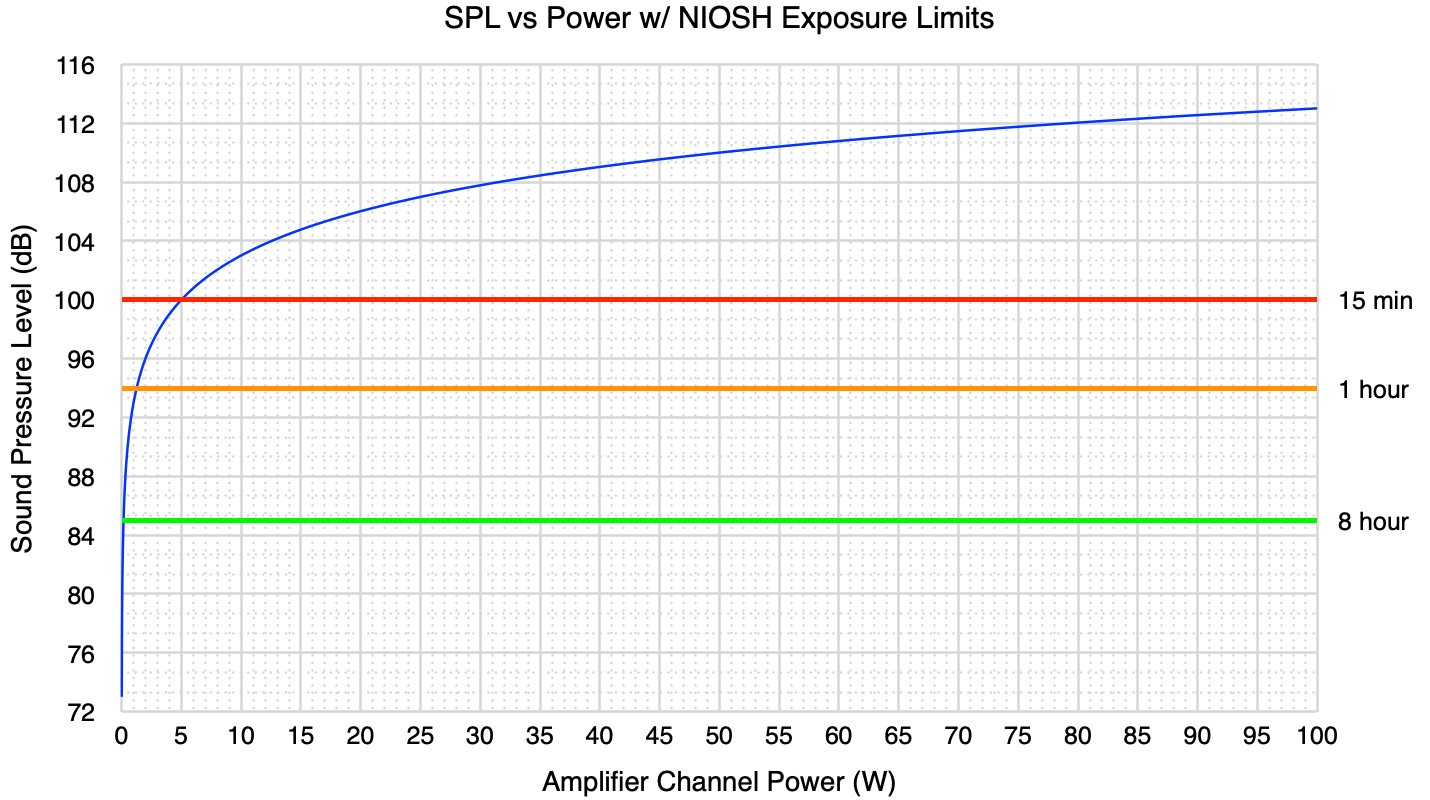
So these time limits start to provide some of that missing context. In addition to these regulatory working limits, here are some examples from real world exposure for some additional context.
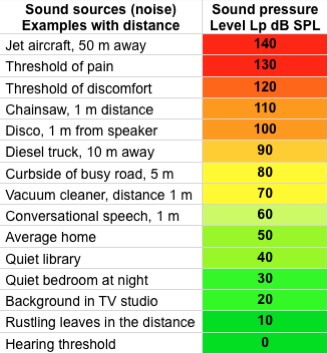
The numbers in this table should hep the average person put some meaning on the SPL scale from the above chart.
While looking at this, just as a check, I got out my audio level meter and took some readings here in my office with the music at a reasonable level. Above background level but not loud. Interestingly enough, the “C” weighted average SPL here in my office read just about 60dB. So about the level of conversational speech but with a larger frequency bandwidth.
Using all the data above, I’m going to propose a reasonable maximum average listening level of about 85dB (or ≈0.35 Pascals). Note that this is loud but generally not considered ototoxic (i.e. damaging to hearing). Personally I find most music at this level very fatiguing and not at all suitable for extended listening. In fact, this is about at the limit where the human ear starts to respond to protect itself. Note that in an occupational setting in the US, sound above this level requires that hearing protection be worn.
The Human Ear Response
Note that when I say “ear” I am including the entire chain of biological sound detection including the outer, middle, and inner ear, the auditory nerves, and that portion of the brain responsible for hearing and sound interpretation. These things cannot be separated. Hearing is a comprehensive biological system and I am discussing it as such.
The human ear is much more than a passive sensory organ sitting on the side of our heads. The ear is constantly responding to sound in the environment. The sensitivity of the ear actually changes dynamically when sound pressure levels change. When an Audiologist takes your audiogram in a sealed and very quiet booth, this represents a measurement of your hearing sensitivity at it’s very best. The data represents what the ear is capable of under the best conditions. When the ear is relaxed and the brain is not distracted by superfluous sound. But the ear doesn’t stay at this sensitivity level all the time.
The sensitivity of the human ear varies based on the ambient sound level. Usually these changes are small. At SPL levels below about 80 to 85dB they are minor and few would ever notice the changes. They vary in both amplitude and frequency depending on the nature of the ambient sound. However, when sound levels exceed this level the ear begins to respond by more sharply lowering the sensitivity level. It usually starts in the higher frequencies because these are the portions of the cochlea most sensitive to damage. This phenomenon is called Temporary Threshold Shift (TTS).
TTS can occur without the person even realizing it. Minor shifts in hearing sensitivity to short SPL excursions, can clear in seconds. But as excursions begin regularly exceeding that 85dB level, the threshold shifts can become cumulative and longer in duration. This phenomenon is obviously dependent on the magnitude of the SPL excursion and how often it happens. A single very loud SPL spike (e.g. a gunshot while standing next to the shooter; ≈130dB) can cause a 10dB to 15dB TTS which can last for hours. But near continuous SPL excursions in the 90dB to 100dB range can cause the same effect lasting from minutes to hours. And regular exposure to SPL exceeding 90dB causes not only TTS but can also lead to a permanent loss in hearing.
This type of sensitivity response is also not uniform over frequency. Different types of sound exposure can lead to different types of threshold shifts. Loud white noise (also loud rock music) leads to high frequency sensitivity loss. Percussive SPL spikes (e.g. shooting guns regularly without hearing protection) can lead to a notch loss in sensitivity centered around the 2kHz range. This is called a Carhart’s Notch. Loud single tones can literally destroy hearing over narrow ranges in the upper frequency ranges. Whether these changes are temporary or permanent depends on the magnitude, duration, and repetitive nature of the SPL excursions. But these changes also lead to another issue; this one in the brain.
Because over 85dB your ear is literally reducing it’s sensitivity to protect itself, the brain’s ability to determine the quality of the sound is greatly diminished. When these sensitivity shifts occur they change the tonal patterns delivered to the hearing centers in the brain. As such, the brain begins to have difficulty matching what it is hearing to established patterns. This means that the ability to distinguish distortion and tonal quality quickly becomes compromised when sound levels exceed 85dB. And by the time that level reaches 95dB any assessment of musical quality and subtle distortion is seriously compromised. This is simple physiology. It doesn’t matter how much “training” or “experience” one has. Loud sounds seriously compromise human hearing and perception.
It is for these reasons that I recommended the 85dB maximum average listening level above. So there are good reasons for this limit from the biological perspective, but what does this mean for our amplifiers?
Requirements for the Amplifier
The first issue to address is the dynamic range of the amplifier. Up to this point I’ve only addressed the average SPL. However, music is anything but average. It is dynamic with a range of sound levels. There are lots of claims about how much dynamic range an amplifier should have at normal listening levels. However, a survey of most musical types shows dynamic ranges of between 20dB and 25dB down to about 200Hz. Below 200Hz some music, most notably orchestral, chamber, and opera, have maybe another 5dB. See this study for more information. However there is usually very little musical content in these registers. In addition, it is very difficult for the human ear to determine distortion or compression in these registers.
Using this data, we can arrive at a headroom allocation for the amplifier. This is a level, above the desired listening level, which the amplifier should be able to handle without undue compression, clipping, or distortion. Using the range values listed above, the assumed maximum average listening level, and splitting the difference yields a peak output level of about 97db to 100dB (i.e 85dB+25dB/2 up to 85dB+30dB/2). Please note this is for both (or all) channels.
If we go back to the example curve above we can see that this puts the peak power requirement for the amplifier (given the assumptions used) at somewhere between 2.5W and 5W. The difference between the two being 3dB. Please keep in mind that this is for a playback level which is fairly loud; even fatiguing.
However, if the 30dB dynamic range window (i.e +/- 15dB) is overlaid on the SPL verses power plot above some interesting trends begin to emerge. I have taken the above plot with the NIOSH limits and scaled the axes to highlight the lower left portion of the ranges. Up to 100dB SPL and up to 5W/channel in power. I have also high lighted a typical 30dB musical range over that plot, centered at 80dB SPL.
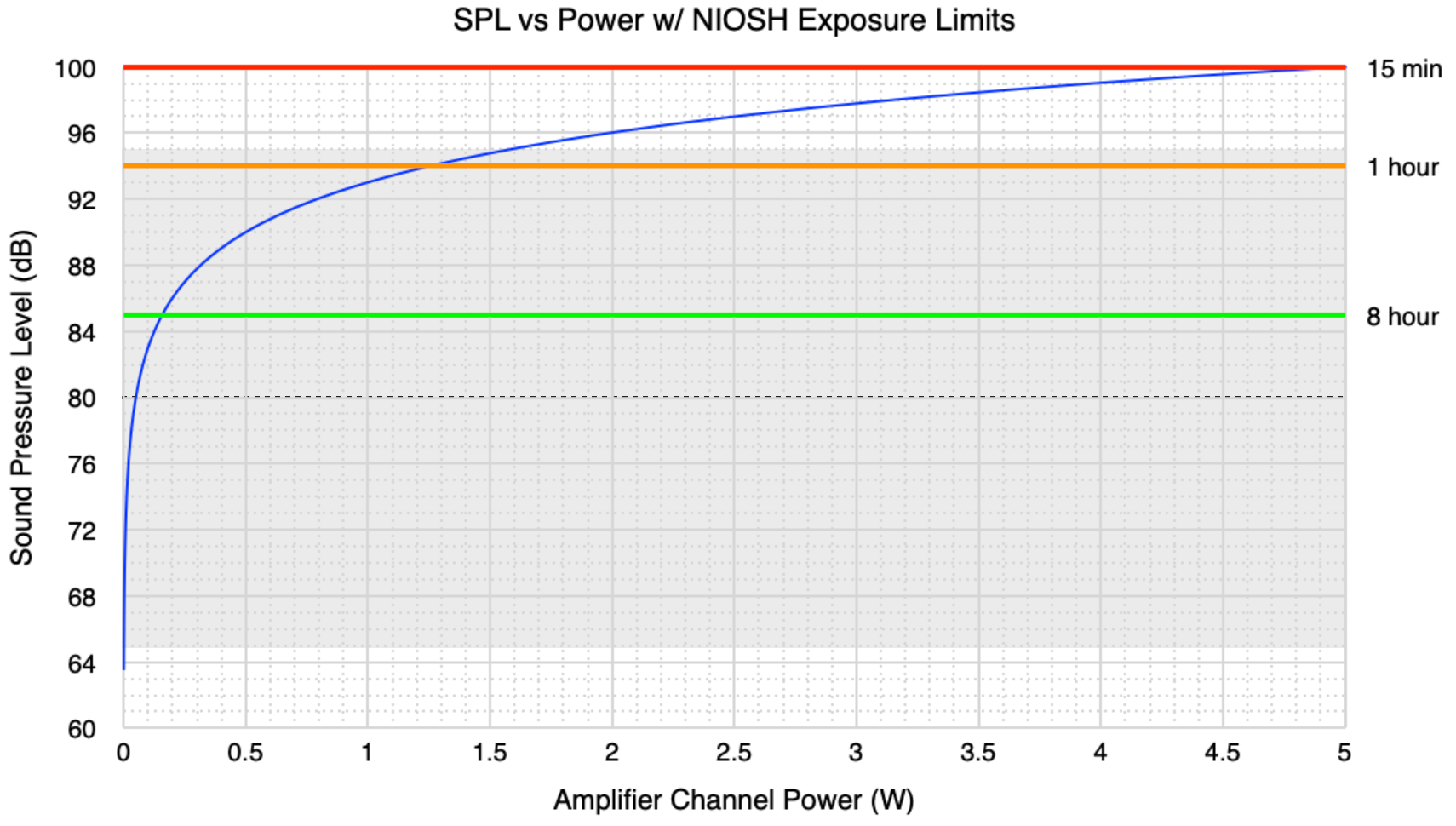
For this case, the maximum peak power required for the amplifier is just about 1.5W. This is an interesting result for a couple of reasons.
The first interesting point is about overall amplifier power levels. This result would seem to suggest that there really in little need for high power amplifiers in most settings. Even with the dynamic range centered at the listening limit of 85dB, the the maximum peak power required for the amplifier is only 5W. And recall that above this SPL, the ear’s ability to judge quality of the sound is compromised. Additionally, each excursion above the average level is likely causing various temporary threshold shifts which is further reducing the ear’s auditory acuity.
The second interesting point is about average amplifier output power. One of my favorite sayings is that most amplifiers spend the vast majority of their operational life outputting small fractions of a watt. The reason for this should be clear from the plot above. Unless you make a habit of listening to rather loud music (>80dB SPL) then the amplifier rarely ever peaks above one watt. And it’s typical output is more likely around the 100mW to 200mW level. And when that level does peak above that 90dB SPL level, the ear is automatically scaling back sensitivity to protect itself and the brain is unable to truly judge the quality (and many times, even the tonal characteristics) of that sound.
And remember up above when I said that the average music level in my office was about 60dB SPL? Well, here is what that plot looks like for that case.
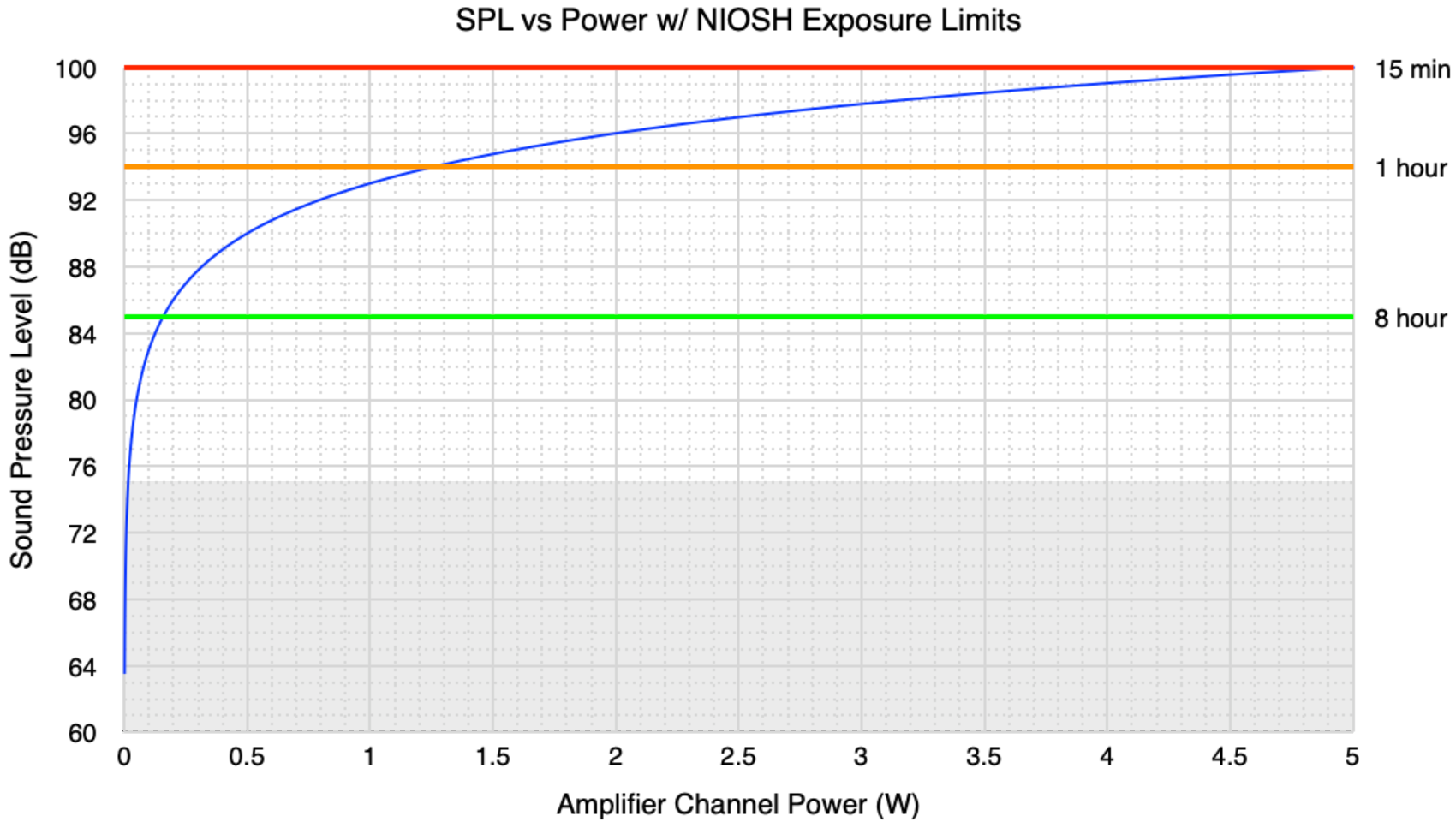
In this case my amplifier is never even exceeding 100mW. And this is not very quiet sound but articulate, punchy, full throated music. Good thing this particular amplifier, The 6EM7 Vertical Amp, goes all the way to 2W per channel.
Now About That Volume Control
In my last post I explained that a single volume control provides an attenuation range of about 40dB. Now the job of that control is to allow you to adjust the peak power of the amplifier down to a nominal listening level. This is why I stressed that a volume control is an attenuator. Without it, a line level input would always produce the maximum SPL the amplifier can produce.
One of the most common issues I hear about privately from people that have built big high power push-pull vacuum tube amplifiers is that the amp is “too sensitive”. What they really mean is that there is almost no volume control room before the music is too loud for comfortable listening. Consider the following plot where I have expanded the vertical axis downward to include some more moderate SPL levels.
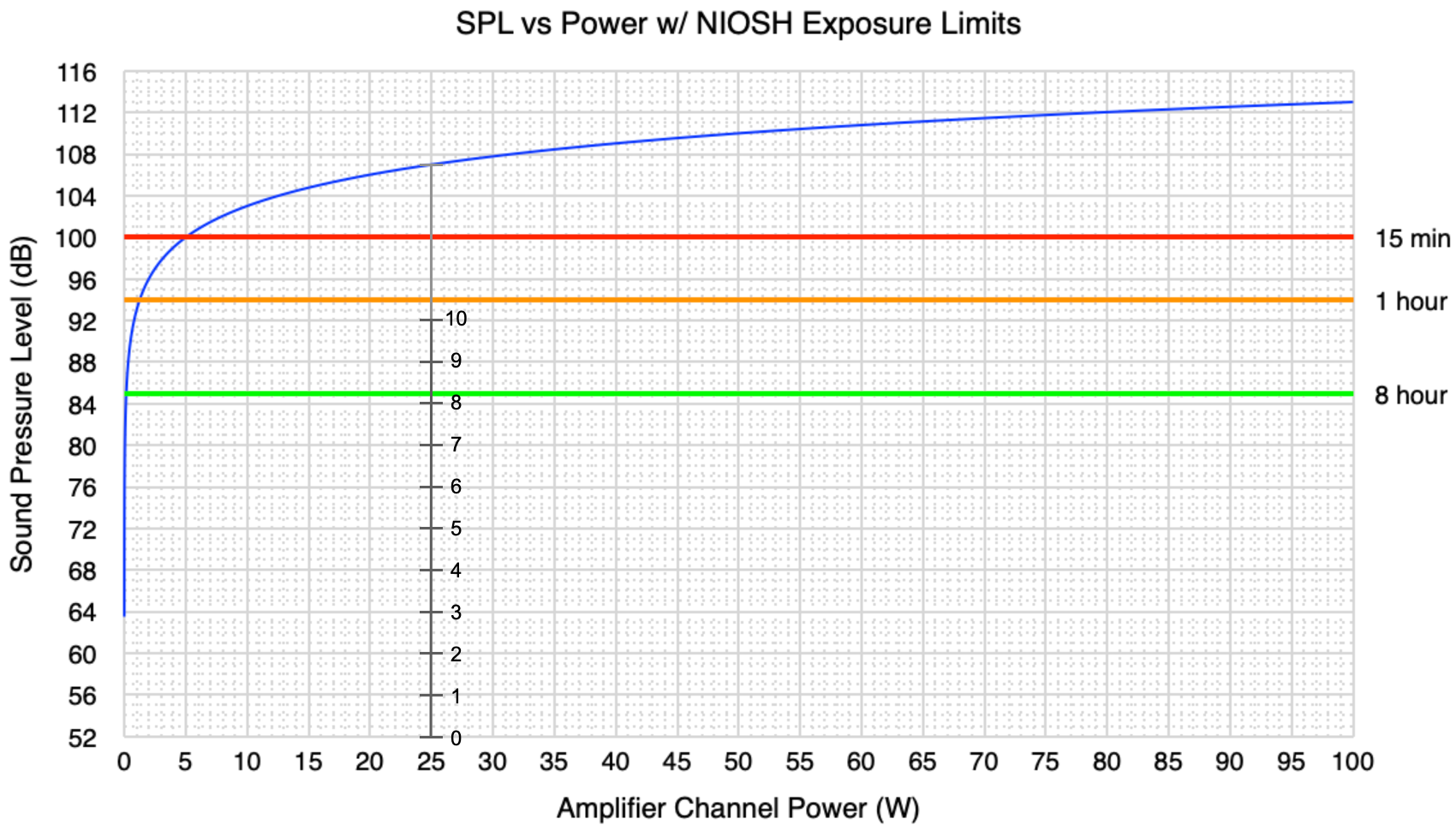
Using the data already discussed I’ve overlaid a volume setting scale offset with the nominal 15dB difference between peak power SPL and the average SPL. With the top of the scale aligned with the peak SPL curve at any wattage, this scale gives a rough idea of the average SPL for any volume setting between ‘0’ and ’10’. I have initially placed this scale at the position for a 25W/channel amplifier.
So with the volume control maxed out, and depending on the music and how it’s mixed, the average SPL is going to be around 92dB. This is loud! In my opinion far too loud for comfortable listening. But what is required to get the average SPL down around where I was listening in my office (i.e. ≈60dB). Then the volume control needs to be set around a ‘2’. And if you want it just a little quieter, a ‘1’. Recall that one number on the 0-10 volume scale is ≈4dB; a small change to overall listening level. And what happens if some background music around 50dB is desired? In this case, the amplifier is too powerful without an addition level of attenuation somewhere in the chain.
About that “Additional Attenuation”
Before going further I’d like to address the argument which suggests just adding additional attenuation to reduce the input signal. This is an option. However, the amplifiers all have a fixed noise figure. This means that with a shorted input, all amplifiers produce a certain level of noise power at the outputs. And, in general, the higher the peak output power of the amplifier, the higher the noise power. But by simply attenuating the input, the signal through the amplifier is reduced and the Signal to Noise ratio (i.e. the noise as our ears hear it) increases. This is a very poor solution to taming an amplifier. In general, if a 60 watt amplifier and a 6 watt amplifier are both driven to the same output power (e.g. 1W) the 60 watt amplifier is going to have about a 10dB worse signal to noise ratio than the 6 watt amplifier. So just attenuating the input signal to get the output power down seriously compromises sound quality at the lower power levels.
Some Real World Examples
The volume scale plot above can be expanded by showing the same volume scale response for several different amplifier configurations. Here is that same plot as before with four different amplifier configurations represented. They should all be easily recognizable.
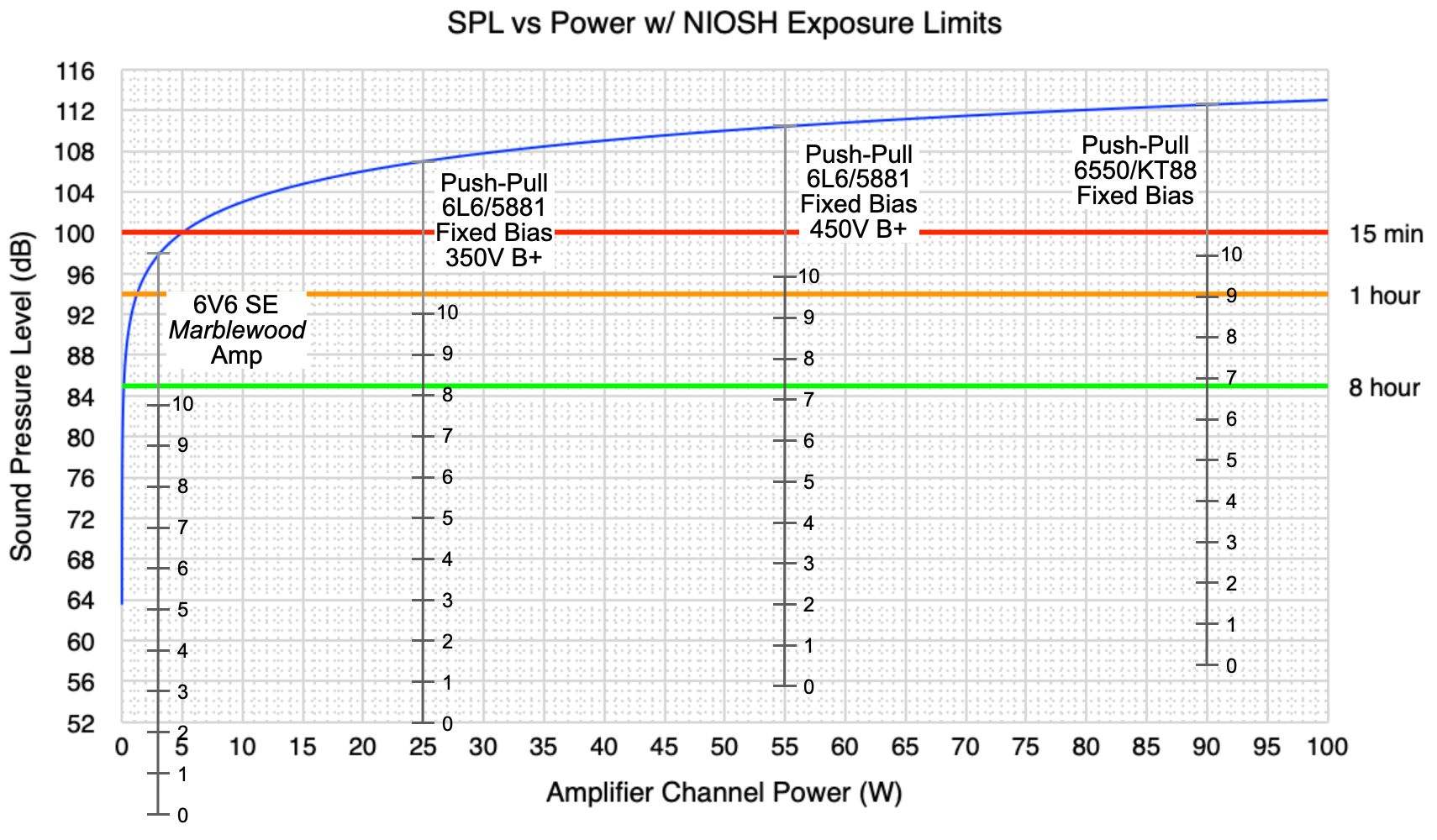
The first amplifier is the 6v6 Marblewood amp from this web site. The other three are some fairly common push-pull amplifier configurations using some popular tubes. At 25W and 55W nominal output power levels are two versions of push-pull 6L6/5881 amplifiers. And up at 90W nominal output is a moderately biased push-pull KT88 amplifier. There are lots of other higher power examples using various tubes, but these three listed should suffice for discussion. These four amplifiers represent several different listening situations worth exploring.
Starting with the highest power amplifier, this is a big 90W per channel amplifier capable of producing significant SPL. However, lets examine the volume scale more closely. Wide open, at maximum volume this amp will be producing an average SPL of about 98dB. At these levels the ear cannot determine virtually anything about the quality of the sound. Serious TTS is taking place and all the the brain will be able to decode is “LOUD”. However, how about at a mid level setting of ‘5″ on the volume scale? At this setting the average SPL will be around 77.5dB and the excursions will be going as high as 92dB. This is not nearly as loud but it’s still a significant sound pressure level. Again TTS will be significantly degrading the hearing response. This is anything but a good situation for music listening. How about trying for that 60dB moderate listening level? To obtain this average level the volume control will have to be reduced to a very low level (≈0.5). And to obtain lower average levels requires additional attenuation to get there.
Moving down the power scale is the 55 watt 6L6 amplifier. At maximum volume this amplifier is giving an average SPL of around 95.5dB. This is lower that the 90 watt amplifier but not significantly. In fact, there is little difference between 55 and 90 watts. Only about 2.1dB, This is almost imperceptible under almost all conditions. This amplifier suffers the same mid-volume problems as the larger amplifier. Very loud average SPLs and significant TTS in the ear. At the lower 60dB SPL level the volume cotrol here is better but not much, a setting of a little over ‘1’. And again, to obtain lower average levels requires additional attenuation to get there.
The third amplifier at the 25 watt per channel level is where some tradeoff may be discussed. At maximum volume this amplifier is giving an average SPL of around 92dB. This is still far above the ototoxic level but it’s getting better. In very large venues where there is significant distance between speakers and listeners, this may be appropriate. But it is still VERY loud by virtually any standard. At mid-volume the average SPL is only 72dB. and the excursions are only reaching about 87dB. Although very loud, at least this level of listening should not permanently damage hearing. It will still be difficult to determine relative sound quality however. At the lower level moderate 60dB SPL level the volume control position is better. In this case it is around ‘2’ which gives about 8dB total adjustment range below this level for quieter listening. For in home listening, this level of power can be made to work without being excessively loud. But it is still significantly more powerful than required for the vast majority of listening conditions.
The final amplifier is the ≈3 watt peak power 6V6 Marblewood amplifier. Here at maximum volume, the amplifier is producing a respectable 83 dB average SPL with excursions up to about 98 dB. I consider this loud, but it is not ototoxic for reasonable listening intervals. TTS will occur so it’s not the best listening condition but it is not impossibly loud like even the 25W 6L6 amp. It’s at the mid-volume level where this power level really shines. In this case, at the ‘5’ volume setting, this amp provides a listening level of about 63dB SPL. This is a good level for dedicated listening which allows a real evaluation of the music without any threshold shifts getting in the way. Excursions are limited to about 78dB SPL which, while loud, are not uncomfortable and allow the ear to fully evaluate the composition and quality of the music. Obviously, at the target 60dB SPL level, this amplifier is only dialed to about a ‘4.2’ on the volume setting. This provides over 12dB of SPL reduction for quieter listening and overall provides a full range of listening levels from a single volume control.
Conclusions
With this discussion I am hoping to show why lower power amplifiers, like the 6V6 Marblewood, are usually perfectly adequate for most listening conditions. Unlike what is commonly espoused on some of the DIY audio forums, high power amplifiers are simply not required in all but a very few special circumstances. I am not attempting to say that higher power amplifiers don’t have their place. In situations where the venue is outdoors or very large, considerably more power may be required. But under these conditions, the quality of the sound reproduction will likely be compromised.
If your use case is indoors and at moderate listening volumes, please don’t fall for the more power hype. The money spent on building a high power amplifier could be much better spent on speakers, other equipment, or physical media. In reality, in spite of the This is Spinal Tap cultural references, there really is no reason to “go to 11”.
And finally, please don’t routinely listen at high SPL volumes. This does nothing but damage your hearing and prevents you from fully appreciating the music in the future. Hearing is one thing that you cannot get back.
As always, questions and comments are welcome.
Great article Matt:
I understand and quite enjoyed this read. One thing I am wondering about is the efficiency of the driver (speaker) you reference for the SPL/Watt discussion.
I use a set up that is quoted as ~ 90db/watt in my living room it is a rear loaded folded horn with a full range single driver. My set up in the shop is an older set of Sansui thrift store speakers. These speakers are from the 09’s so I speculate they are 84db efficient not sure though.
There seems to be a significant efficiency difference between these two speakers. Perhaps you could discuss driver/speaker efficiency. It would put a bit more meaning to the Watt to SPL discussion. As I believe there is more to it than just Watts. The speaker plays an important role as well.
Thanks
I agree that speaker sensitivity is typically ignored by many builders. I have seen builders spending a couple of thousand dollars extra on a build attempting to get 100W/channel rather than spending a few hundred to get high quality modern speakers which make all that power superfluous.
The nice thing about speaker sensitivity is that it’s just dBs. So a little addition tells the whole story once you understand what Sound Pressure Level (SPL) numbers really mean. I think the real issue is that most people don’t stop and think through what they really need before they start. Or worse yet, they let someone on the internet tell them what they need without understanding their own requirements.
Maybe I’ll do a post on speaker sensitivity. I remember a run in I had with a set of Audio Research AR2x speakers. Even after full refurbishment these speakers had horrible sensitivity. And worst, they were horribly inaccurate at low volume levels. Frankly, most mid-price modern speakers put all those old designs to shame. Frankly, I would take a set of Cambridge Audio SX60s (with their 89dB sensitivity) over most of the “vintage” speakers espoused by people on the internet today.
I think an article on speaker sensitivity would be of great value to everyone. I also agree that most DIY folks get a little excited, when getting started and do not really spend the time to think about what they are really after.
It is hard to help someone focus their enthusiasm to get the best value for time and money.
For me this is more of a voyage of exploration and quest for knowledge than achieving a specific outcome.
Thanks again for the sharing your work.
I would enjoy hearing your thoughts on this too, since there seems to be a lot of gray area in standards.
I have a SET amp, and volume levels are fine for the workshop. The outlier in the discussion, though, might be bass.
Good point.
But…
Good bass is largely a function of the speakers and their placement in the room.
Typically, drivers that go lower have lower sensitivity. Designers then bring down the tweeter to give the speaker linearity. The system solution to lower SPL in speakers is higher wattage in the amps.
Tube amps add a wrinkle because of material limits. Matt wrote about this in his Quest for 20Hz post. I wonder if there is a sweet spot for tube amps between OT size, Tube power, and speaker SPL.
For example, is the best proverbial bang for buck 3 watts from a 4w speaker using a 10w OT with a 91 Db speaker? I am curious to hear how Matt would approach this 3 Body problem.
Ciao a tutti da Palermo.
Se ho ben capito stai valutando l’idea di modificare il progetto dell’ acero riccio?
Angelo
> Hello everyone from Palermo.
> If I’ve understood correctly, are you considering
> the idea of modifying the curly maple project?
No. Actually the Curly Maple is an update of the Marblewood design. If I ever get the time I will post the official project page for that amplifier.
My experience in a 20 x 20 x 8 carpeted and furnished room.
50 dB comfortable listening level.
60 dB pleasantly loud.
75 dB too loud to enjoy.
90 dB annoyingly ear shattering.
I agree with your assessment. 😀
A side note: My 20 WPC. Receiver in my rec room easilly hits 90 dB before being turned up to 10. (87 dB speakers).
Point is – for home audio 20 WPC is way more than adequate.