I know that I said I wasn’t going to do a lot of posting about my new project, but this morning’s session is worthy of a quick note.
So I set out to start the chassis for the new project today. It was not going to be anything special, just some nice wood in a typical ring frame. And for the chassis I chose a nice piece of Bloodwood (Brosimum rubescens). This was one of the options a couple of years ago when I was making some decisions about what wood to use on the 6AS7 SET amplifier. It is the second from the left in this picture. The one with the striking grain.
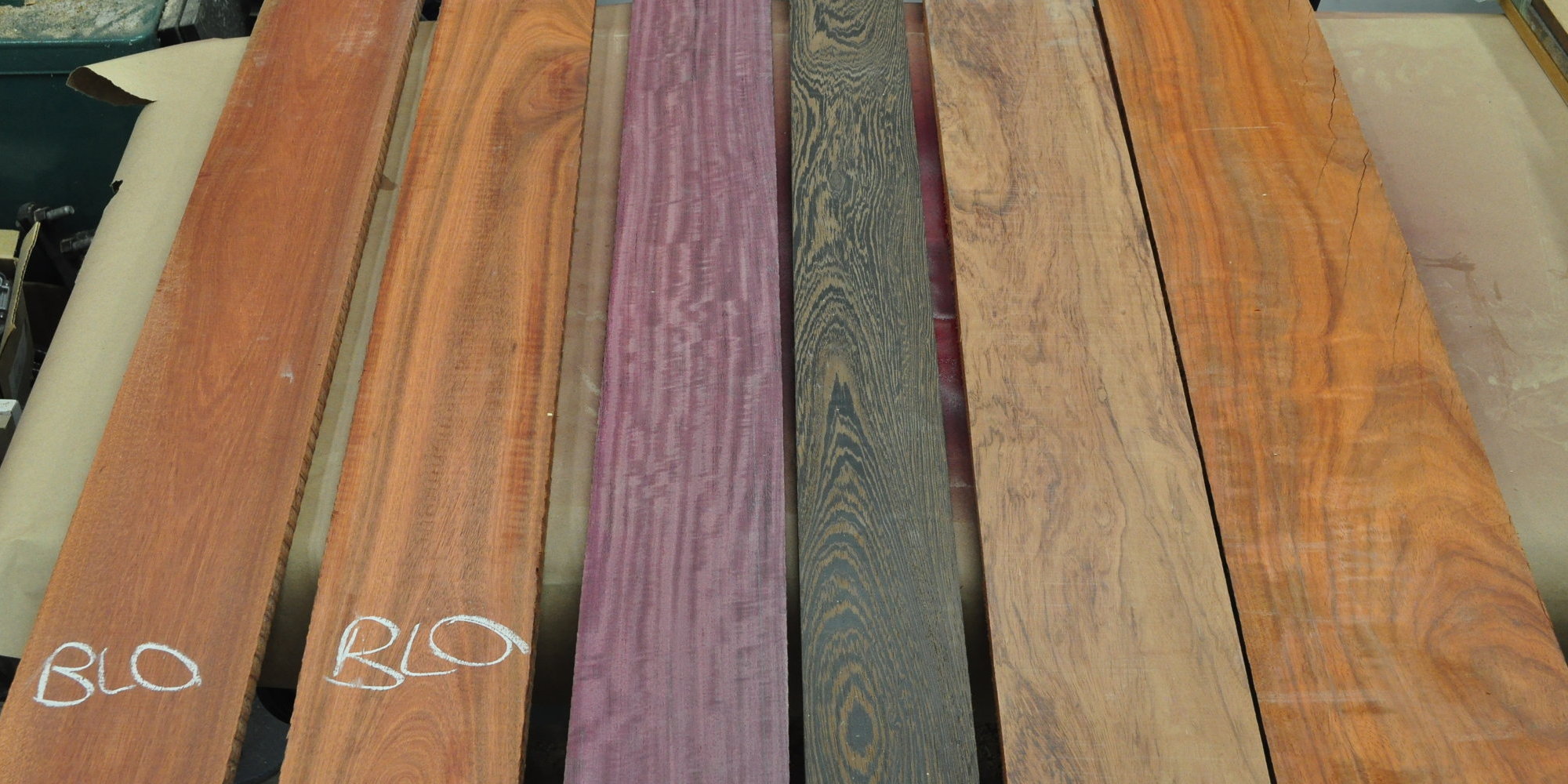
Those with a good memory will recall that I had originally chosen the leftmost Bloodwood board for the source selector chassis. However, after looking at that board I decided that a distinct twist might give me trouble, so I chose the African Bubinga (Guibourtia spp.) board, second from the right, instead. Well, it suffices to say that the two pieces of Bloodwood shared a defining characteristic. This piece of lumber had more twists and turns than an Alpine goat trail!
I finally got the raw boards for the new chassis complete this morning. I haven’t cut any of the joinery or openings yet. But I do have four square and true, properly sized pieces of Bloodwood. Here’s the proof.
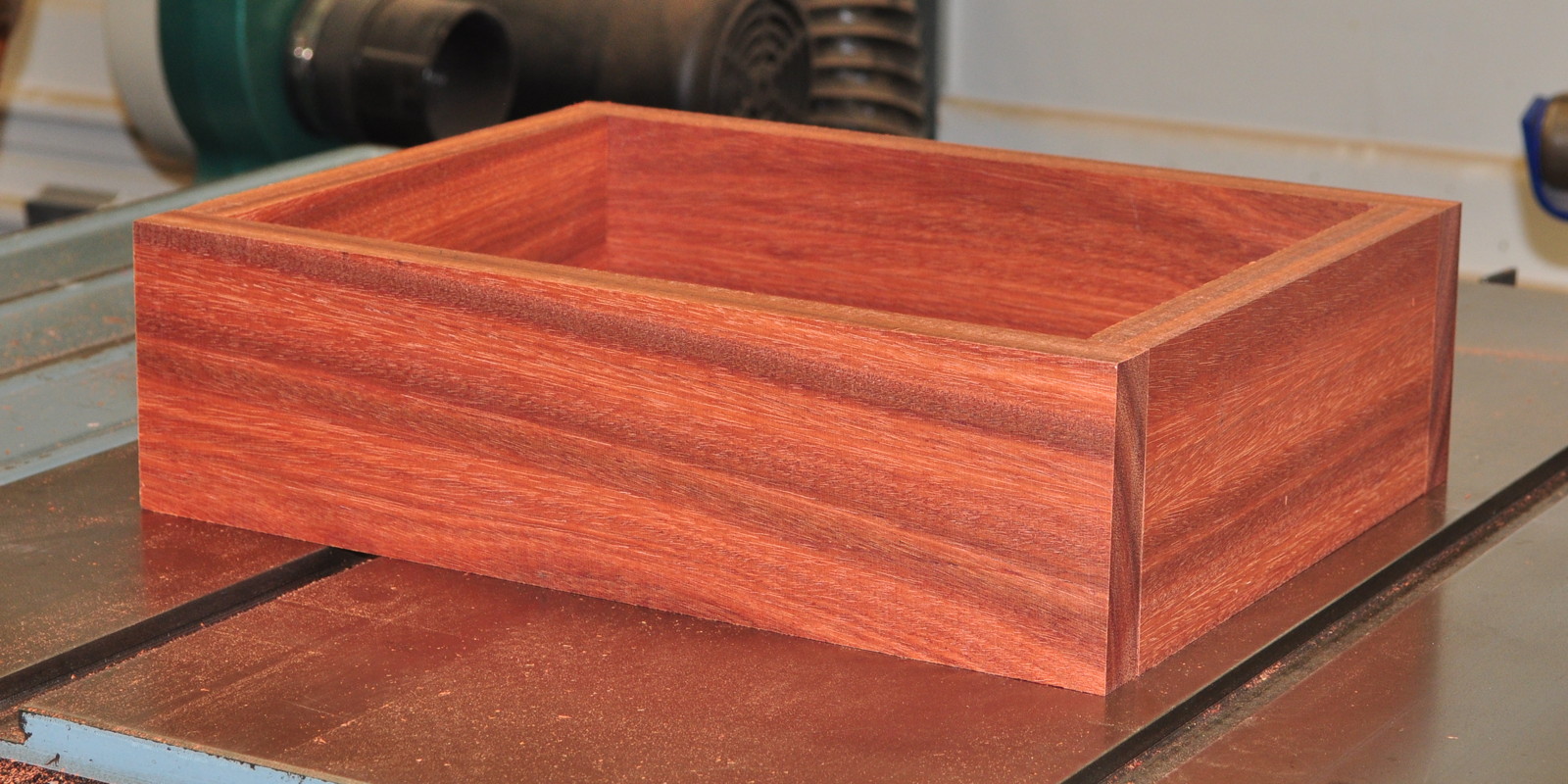
But those four little boards represent about three hours of hard work. The steps required were as follows:
- Crosscut the board into two pieces. One for the front and back and one for the sides.
- Joint a straight and true edge on each board.
- Rip both boards to final width plus 1/4 inch.
- Cut two over length pieces from each piece so that I had four blanks.
- Each blank needed to have one side flattened on the jointer to remove cup and twist. This took quite a while.
- The single edge of each piece needed to be jointed again so that the guide edge was square to the flat face.
- Each over size piece than had to be planed to the required 3/4″ thickness so that the sides were parallel and true.
- Each blank was then ripped to final width and jointed to clean up the edge.
- Then the four blanks were cut to final length in preparation for cutting the joinery.
And after all this, I still haven’t gotten to the hard part.
There are lots of woodworking videos on the internet showing how to make some project. Everything from cutting boards to fancy furniture. Just about every one of them says something akin to “choose some straight and true lumber”. And they virtually never show the sometimes substantial work just to get some straight and true edges. Usually it’s just feeding the board into a machine or maybe generating a few shavings with a hand plane. There’s often a lot more work that gets completely skipped over. And woodworking isn’t like machining a block of metal on a mill. It’s much more nuanced than that.
Woodworking is more like a conversation between the wood worker and the piece of wood. What stresses are built into the wood which will come out when cutting starts? Are there any hidden flaws, crack, splits, or knots that are going to affect the process? How much has the wood moved since it was put on the rack? And how much will it continue to move once the project is finished? And each board is an individual. Each one has it’s own personality. Try and force the wood into shape and things won’t go very well. Work with the wood and projects can really come together nicely.
So if there is anyone out there thinking that my chassis just magically come together, that’s not really the case. Each one is really it’s own project; it’s own conversation if you will. And in spite of the work and effort required I love the process of working with the wood to make the chassis come together.
Now it’s time to begin laying out the joinery for this project. Back to work.
As always, questions and comments are welcome.
Pingback: Well Worth the Trouble | Cascade Tubes
I spend more time working with metal than wood. I do know the conditioning (or lack thereof) and humidity control during production and storage are major factors. Kilns and humidity monitoring/control are used to relieve stresses. I also know home improvement centers do not contain a single piece of straight lumber.
Yes conditions are critical. But one thing that over 40 years of woodworking has taught me is that there is no such thing as a stable piece of lumber.
Also, most home improvement centers get lower grades of lumber from suppliers. If at all possible, always get construction lumber from an established lumber yard and you’ll get much better product. And it you do find a bad piece, most reputable lumber yards will exchange it without question.