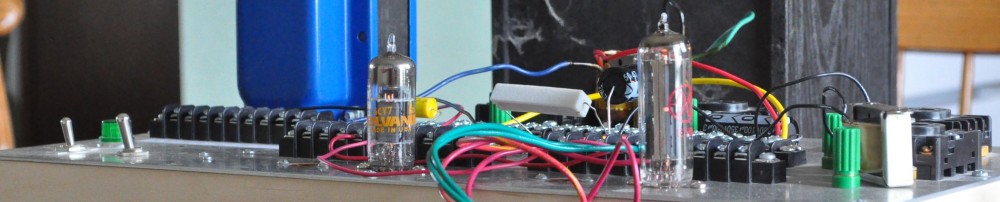
Those paying attention to my post from May 9th already know I have a new project coming. This one is nothing new or Earth shaking. Just a slight performance upgrade to the 6EM7 Vertical Amp in a more traditional chassis.
There are a couple of things about the original design I wanted to revisit. The first is the overall bandwidth. I believe that I was a little too conservative in my original design and I’m correcting that decision. I’ll be chasing a little lower f-lo and tailoring some of the capacitors where excursions are not an issue due to the overall design points. I also chose a slightly different bias point for the power stage which slightly increases peak power and reduces the distortion per watt by a commensurate amount. The second thing I really wanted to revisit is the chassis.
Lots of people view the project page for the original amp but I don’t get many questions or comments. And, with a few notable exceptions, there are not a lot of builders choosing that particular amplifier. It is my hope that with the demonstration of a more conventional build approach, more people will think to give it a try. I think some people are scared off by the whole vertical chassis approach.
Here is the schematic for the new version for comparison to the original.
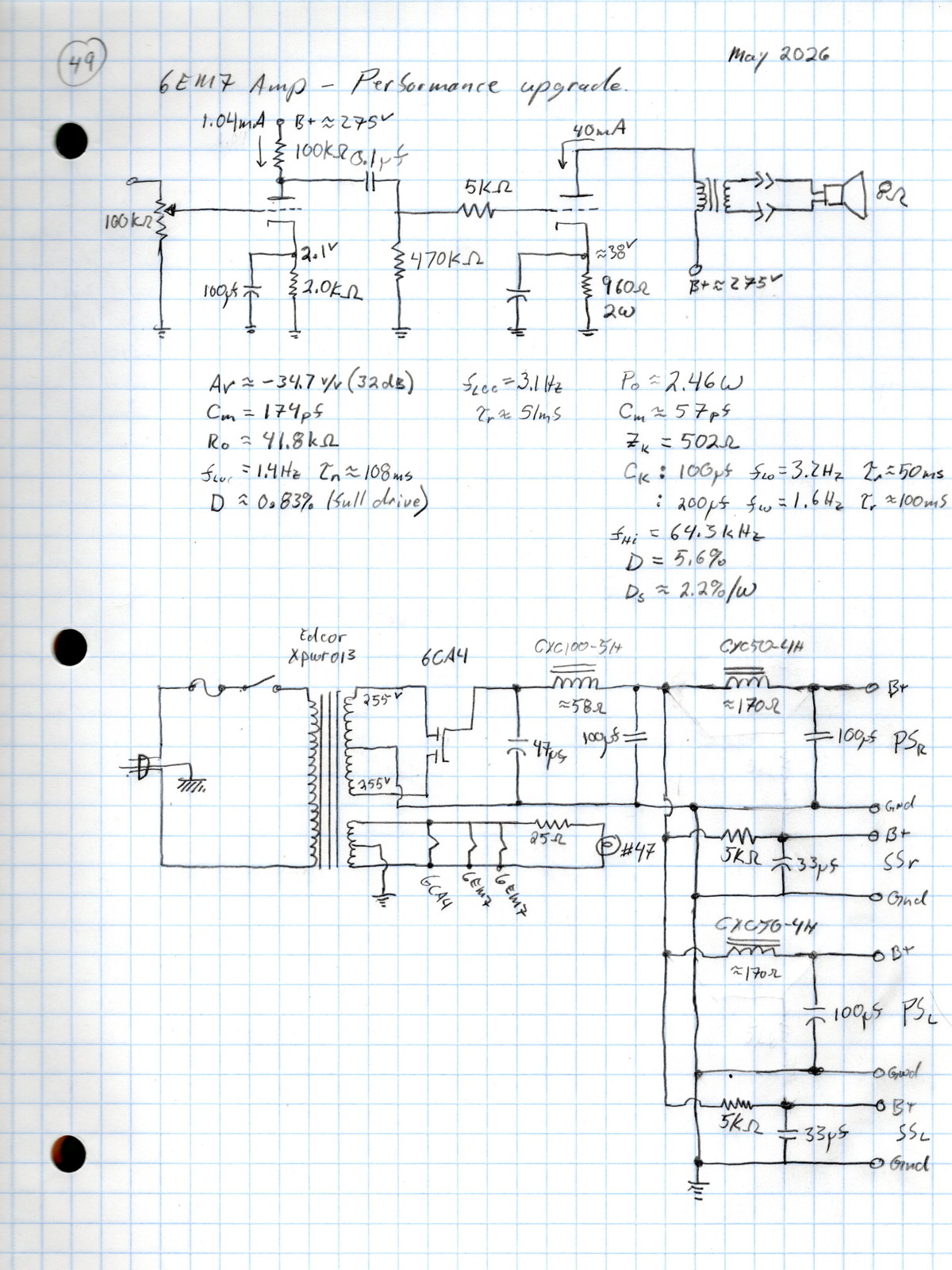
The larger coupling and bypass capacitors are in evidence as are some changes to the power supply.
I’ve chosen bias points assuming a slightly higher B+ voltage. This means that with any luck I’ll be able to forego the dropping resistor in the supply. I’ve also isolated the signal stage supplies from the power stage supplies to improve the sound stage a little. And there won’t be an indicator brightness adjustment in this one. The top plate is only 12″ by 9″ (30.5cm by 22.9cm) and that didn’t leave enough room on the back for the adjustment control. That’s okay as I’ll be using the same approach I used on the Marblewood power indicator.
I’m not planning a lot of blogged updates on this project. Maybe just a couple of updates and the final page.
As always, questions and comments are welcome.
Thanks for the updates! For what it’s worth, I wasn’t scared off! I just admired the cool chassis and then did something different. I built two separate wood chassis for the power supply and amp, connected by a multi-conductor cable with octal plugs.
I don’t think I can post photos here but here’s a link to what I did:
https://ohm.bu.edu/~hazen/TubeAmp/#vert
If I get bored I might try to build a new power supply following your updates and tweak the amp.
Nice looking amplifier.
Thanks for the link. I enjoyed checking out your projects!
I can identify with the person you described who looked at the chassis challenges more than the schematic features. I am excited to see what you do in V2.0. As always, I am a big fan of your SET ideas.