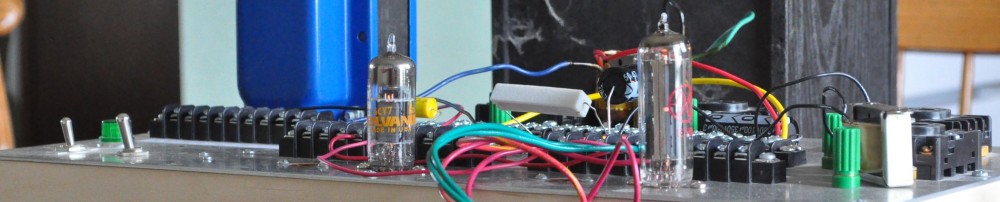
There are a thousand small decisions we make when building a project. Some matter more than others. But anyone who’s built several projects knows that sinking feeling one gets when either you don’t have, or can’t get, a specific component called for by a design.
It’s a familiar situation. You have a design you want to build and you begin sourcing components. And for whatever reason, either because you don’t have it in your parts stash or your favorite supplier doesn’t carry it, you can’t easily acquire what you need. Then comes the decision: Do I scour the internet looking for that exact part, or do I “make do” with something close that I already have or can get? It’s never a simple decision. There are always tradeoffs. But, in most cases, there is actually considerably more leeway in a design than most people realize.
I encountered this exact situation when pulling together the parts for my latest project. It all started with the primary filter choke. In the design, I started with an Edcor CXC100-5H-200mA choke. This is a big end-bell equipped choke. But it was also too big and heavy looking for the simple clean layout I wanted. So I thought I’d use a Triad C-14X 6H 200mA choke under the top plate. I always have several of these in my parts stash. But then I looked and realized that I hadn’t ordered any after I used my last one. However, I did have a Hammond 159S 4H, 225mA choke I had removed from an old project. This choke is the exact same size as the Triad. It would yield slightly less primary stage ripple reduction (47dB verses 49dB) but the overall filter performance had margin so I decided that was acceptable. Disaster averted.
Then came the first capacitor issue. The power supply design called for three 100µf filter capacitors. So I opened up my filter capacitor supply and looked for the 100µf capacitors. I had three but they were all from different manufactures. This is not an ideal situation, but it really won’t make any difference. There are some internet bloviators who would scream at me that the amp will be “unbalanced” or some other such foolishness. But I know better. So I put the three capacitors in a parts bag and soldiered on.
Then came the next capacitor problem. The power supply design calls for one 47µf and two 33µf filter capacitors. The 47µf one for the primary reservoir capacitor after the rectifier and the 33µf capacitors for signal gain stage power filtering. But I didn’t have two 33µf filter capacitors. I did however have a handful of 47µf capacitors. So three 47µf capacitors went in the parts bag. This means that there is a little higher ripple reduction for the gain stage power supplies (45dB verses 42dB) but this offsets the reduction 2dB in the primary filter with a 3dB addition in the signal filter. So this should work out well.
Then I looked for bypass capacitors for the signal stage. I did the design assuming 200µf cathode bypass capacitors on the power stage triodes. One problem, I didn’t have any. So I had to order some with my 960Ω/3W bias resistors. One issue, the 200µf capacitors were a specialty item costing several dollars each. However, the supplier had 220µf/63V capacitors (a standard value) for only 34 cents each. Anyone who’s already read my two articles on cathode bypass (Cathode Bypass and Frequency Range and Cathode Bypass and Frequency Range, Part II) already know this won’t have any meaningful effect on amplifier performance, so those when on the parts order.
Then came the coupling capacitors. I called for two 0.1µf/400v “orange drop” capacitors in the design. But all I had were 600v 715/716 series capacitors which were to large for the layout I had done. I did however have a whole bag of compact 0.1µf/400v series ECQE(F) capacitors from Panasonic. Not the usual Cornell Dubilier 715/716 series I normally use, but the change will be indistinguishable.
None of these decisions will have any real world, or even measurable, effect on the performance of the amplifier. In some cases they are not even the same values as called for in the initial design. But my whole point is that these are the types of minor changes I make all the time when building projects. And for the most part, such changes will not materially affect the performance of the final project. So go ahead, use what you have. So long as it’s close your amp should be fine.
As always, questions and comments are welcome.
I have run into that situation many times in my professional career. Due to various factors, the exact component or device is not readilly available. So, you pick the closest functional equivalent with little to no effect on the performance of the equipment. Happens all the time when building custom automatìon systems on tight, customer driven schedules.